Brexit and Migration


I truly dislike talking about human beings solely as resources for the economy. We are not just pieces of business machinery. Each one of us has a heart full of aspirations, emotions and memories. We are loving neighbours, mothers, brothers, sons and friends to other people who love us too. We have talent, culture and spirituality, whether it is religious or not. We share humanity with everyone. We are the Rivers of Life feeding the Oceans of Hope.

However, since the debate about migration in this EU referendum has focused mainly on how migrants contribute (or not) to the economy and on how to “control numbers”, often with demeaning language, I feel the need to share with the readers a reflection, primarily in economic terms, about migration. Sadly, these are the parameters of the debate and responses on these grounds are also needed. Unfortunately, the urgency of the situation requires it. The stakes are high.

The referendum campaign has been tarnished by very sad episodes of political abuse and even violence, including the tragic death of Jo Cox, a brave woman who defended noble ideas and values and served her community and the country with diligence and enthusiasm. Leaving the EU, as we may be about to do, led by a right-wing movement that rides high on the back of the beast of media xenophobia, fanatic patriotism, dubious democratic claims and self-interest (a movement whose messages have surprisingly captured the imagination of millions of decent Britons!), will be catastrophic for our country.

The debate about the effects of EU migration on the UK economy is simply misguided. Many Brexiters do not acknowledge that EU migrants fill in positions that the local workforce cannot. Migrants are also consumers, pumping up Britain’s GDP figures. Crucially, reputable studies have demonstrated that the value of taxes paid by EU migrants in Britain outweighs the value of the public services that they receive. It is true that different methodologies to calculate the net contributions throw out different figures. Quantifying this is not easy, as shown in this study of the University of Oxford. However, nobody  challenges the fact that EU migration into the UK has been, in fiscal terms, beneficial.

Nevertheless, one of the important points I want to make about migrants’ contribution is that there is a big elephant in the room that nobody talks about in any of the studies cited during this campaign by any of the camps. I call it the “Migrant Premium”, as there is not an easy straight forward term to define it in econometrics, but the premium falls under the well-known category of “human capital gains”. This concept extends beyond any comparison between migrants’ tax receipts and migrant’s use of public services, as it refers to the impact on the wider economy, not just on the public purse (1).

What is the “Migrant Premium”?

If we look at the figures, the cost of bringing up a child in the UK from birth to adulthood is at least £40,000 at 2016 prices. This figure only covers education and health. The cost of state schooling comes to more than £22,000 (2), whilst health costs are in the region of £1,000 a year for younger age groups (3). If we add health and university fees costs for the 19 to 22 year-old group, we have an extra £30,000 on top.

When a young non-university educated migrant comes to Britain, ready to work and pay taxes, he is saving at least £40,000 to UK Plc. If it is a graduate, just with a 3-year degree, that figure goes up to £70,000. This is the replacement cost of that influx of human capital per person.

There are many different ways to calculate the Migrant Premium and I look forward to old and new studies on this matter, but the above estimate is, if anything, on the low side. Bear in mind that we are not including here any other costs, such as maintenance, housing or any other private or public spending that the young person benefited from directly or indirectly in his or her country of origin.

The Migrant Premium surely plays a role in sustaining the U.K. Economy. Our country has been able to increase, on demand, its working and tax paying population without having to invest huge amounts of money. Migrants land in Britain and start paying taxes as they begin consuming and working.

Conversely, the Migrant Premium is a “migrant loss” for the countries whose public services have subsidised the health and education. Basically, the U.K. and other Western economies “import” ready-to-work human capital for free. Germany, when it comes to EU migration, and the United States are our main competitors in attracting human capital. Regrettably, this important asset migrants bring with them to the UK’s economy is not taken into account in any of the calculations disseminated in the media about the benefits of migration. If you find one, please share it in the comments.

Brexiters with an understanding of economics know, in broad terms, about the Migrant Premium, but they don’t want to acknowledge it because it gives breathing space to the opposite camp.

In my discussions with people who intend to vote Leave, whenever I have been successful to demonstrate the immense benefits of migration to the UK, I have then been confronted with other migration-related arguments that would justify leaving the EU. Here they are:

The all-time favourite Brexit icon: an “Australian point-based system” 

This system does not stop or reduce migration. It just provides a sense of control and allegedly filters migrants according to their “quality”. This is a very classist and perverse idea, as it could create a two tier workforce: the low-paid workers, made up primarily of UK nationals and some pre-Brexit settled down migrants, (the points system would stop people without high professional qualifications to come to the UK) and the better or well-paid workers, which, as the proposers of the points system acknowledge, will be, proportionally, made up of more and more highly educated workers from abroad. The points system would allow to fish for skills in a wider sea and perpetuate the situation of underinvestment in training and education for professions such as doctors, nurses or teachers. If their governments in their respective countries train them for us for free, why bother? I am afraid, business principles dominate Conservative-UKIP political practice.

What is the other problem with the Boris’ and Nigel’s “Australian system”?

In an economy like ours, or Australia’s, younger workforce is essential. Businesses need it desperately. That is the reason why people come here. Make no mistakes, U.K. Welfare is not available for newcomers and is not good enough in itself to justify coming here, anyway. The freedom of movement provided by membership of the EU enables changes in supply and demand for labour in any country to be self-regulated, without State intervention. Additionally, the EU is a massive space of 500 million people where to find the right professional profiles when needed.

I am not a believer of free markets as the best solution for many human needs in our society, but I have to say that I very much value the freedom of taking up whomever one thinks is best for a job, or choosing for whom one works. If I ever set up a business again and need someone to work for me, the last thing I want is to fill in immigration forms, ask prospective candidates to fill in even more forms and expect Boris Johnson’s army of Whitehall Bureaucrats to make a decision about who I should take on for a job based on the points system they have designed. There is not anything as illiberal and centralising as that. Employers know who they need and why, employees know who they would want to work for. It is their decision. The EU enshrines precisely that principle through the free movement of workers in our common space.

Some people argue in favour of this points-based system by defending that non-EU citizens should not be discriminated against EU citizens, despite the fact that non-EU migration in the UK remains stronger than EU migration according to Migration Watch. Fair enough. Let us create a system that gives non-EU citizens easier access to jobs if needed. But leaving the EU and imposing restrictions on everybody is a massive step backwards that do not really benefit anyone at all.

Undercutting and discrimination of UK nationals

The other argument used by many to defend a vote for Leave is the very legitimate concern about  local workers being undercut.

I do believe we should work harder to eradicate any business practice that effectively discriminates local workers. David Cameron stated in PM Questions this week that his Government was taking action against agencies that only recruit foreign workers. This was in response to a question by Labour Leader, Jeremy Corbyn, who has shown that working conditions and rights are again at the heart of Labour’s agenda. The enforcement of a (higher) decent minimum wage should also be pursued. Finally, as a through study by CERIC Leeds shows (4)  “The Brexit scenario would have even more detrimental effects on the employment and bargaining rights of both UK nationals and migrants.”

Population growth and public services provision

This is of course an understandable concern. In my view, however, the biggest issue about the UK’s alleged overpopulation is that there are areas in the South of England that are real magnets for UK migrants (internal) and non-UK migrants. Their economic growth out-paces everyone else’s in the country. Other areas, particularly in the North, have registered very slow growth in population recently. Blackpool and Sunderland even lost population between 2007 and 2012 (5). The density of population of the U.K. is not that high at all. We are not even in the 50 most densely populated countries in the world (6).

Obviously, the unbalanced distribution of wealth, opportunities and population in the UK has nothing to do with the EU and is a serious problem that will not be solved by leaving the EU. If anything, the poorer areas of the UK will lose out even more by leaving the EU, as the dependency on manufacturing jobs is much greater there than in the South East and this is one of the sectors who would suffer the most. Successive UK governments in the last 40 years have not done enough to redress or alleviate this imbalance. It is their (our) call.

Insofar as the provision of services, the “Migrant Impact Fund”, which was introduced by labour and withdrawn by the Tories, is back on the cards and should be used as a policy tool to ensure that a higher amount of the taxes generated by new local and foreign arrivals in any given area are dedicated to the public services of that area.

Thank you!

All in all, we should be thankful to our migrants for choosing the UK as a destination for their Migrant Premium. We all know they are also grateful and happy to be welcome amongst us. They could have chosen Germany, Holland or Finland, where in-work benefits, public services and wages are better than here, but in instead they joined us. We must be doing something right as a nation. Let us be proud of it.

Let us remain in the EU.


Notes

(1) Methodology: The purpose of this part of the article is to highlight the indisputable existance of a substantial Migrant Premium of at least £40,000 at the time of the arrival of the working migrant in the UK. Therefore, the valuation of that premium has been kept on the low side and “replacement costs”, as suggested by Bowman (below), have been used. This is not a longitudinal study of the actual returns of the human capital brought into the economy by each migrant over time and it assumes that the migrant is ready to take a job. There are longitudinal (over the time) studies about the benefits of migration in terms of human capital, but as I suggest when I discuss the question of tax receipt vs public expenditure (Oxford University study cited), the problem is that there are so many different methodologies used to quantify the flows of capital that we run the risk of not acknowledging the existance of obvious magnitudes such as the Migrant Premium for not having found total agreement amongst economists and statisticians on how precisely to measure it. Two recommended readings for those with a professional interest on this question:

Bowman, M.J. “Principles in the Valuation of Human capital”. Review of Income and Wealth. Volume 14, Issue 3, pages 217-246, September 1968

Schaeffer, P. “Human Capital, Migration and Brain Drain”. Journal of International Trade and Development. Volume 14, No 3, 319-335, September 2005

(2) http://www.telegraph.co.uk/finance/personalfinance/10169865/Costs-for-state-school-hits-22500-per-child.html

(3) https://www.theguardian.com/society/2016/feb/01/ageing-britain-two-fifths-nhs-budget-spent-over-65s .

(4) https://cericleeds.wordpress.com/

(5) http://www.centreforcities.org/blog/population-growth-and-migration-in-uk-cities/

(6) https://simple.wikipedia.org/wiki/List_of_countries_by_population_density

Picture credits: http://www.weforum.org https://www.weforum.org/agenda/2016/01/how-immigration-has-changed-the-world-for-the-better/


Beautiful England

“wert thou the unicorn, pride and wrath would confound thee and make thine own self the conquest of thy fury” W. Shakespeare, Timon of Athens, Act 4, scene 3, c. line 341

Oh Beautiful England,

Green maid
Longed for
By warriors
And nomads
And traders
And workers
And dreamers
From Abroad,

Whose Children,

Sometimes blond
Often not,

Have turned you
Into a mirror,

Into a mirror
Of the World,

Tell your sister,
The other England,
Who still believes St George
Was from Windsor
Or Newcastle
Or St Albans
Or Stoke,

Tell her,
For our peace of mind,
Tell her
Who her real parents were.

Tell her
That it’s millions,
Many millions,
Of all tongues,
Who make you
Very fertile,
Who balance
All her books.

Tell her
To stop drinking
Gin and tonic and Pimm’s.
Tell her
To sober up to reality
Tell her

To embrace
Her Foreign Kith and Kin.

Copyright © 2016. Tony Martin-Woods
Todos los derechos reservados. All rights reserved.

Painting: Happy unicorn and a naked virgin. Rothschild Canticles. Flanders 14th century. Beinecke Rare Book and Manuscript Library, MS 404, fol. 51r from  by Hieronymus Bosch (c. 1450-1516). Source: https://uk.pinterest.com/elenakarasiova/


Anochece que no es poco en Brexit

Day 2 in the Brexit House. Los medios y los televidentes hemos disfrutado de lo lindo. Seguro que los políticos no tanto.


image.jpeg

Boris Johnson, alcalde conservador de Londres, se ha convertido en todo un símbolo del brexismo. La naturalidad exultante de sus ademanes de niño rico travieso que se ha comido la caja de bombones a veces juega a su favor, a veces en su contra. Hoy las cámaras de todos los telediarios le han encontrado a Boris su lado rebelde: A la entrada de Westminster, los periodistas le atosigaban mientras él respondía con chascarrillos. Con su anorak, su bici, su mochila y su gorro del Metro de Londres, Boris se perfilaba tras las lentes mojadas de las cámaras que lo perseguían como un personaje atormentado. Sus tribulaciones: haber roto aún más su partido, enfrentarse a su amigo de la juventud David Cameron, ser acusado de egocéntrico que usa su postura poppulista para promoverse como sucesor de Cameron y haber contribuido al batacazo de la libra esterlina, que hoy alcanzó su mínimo de los últimos 7 años frente al dólar.

image

Ya los asientos del Parlamento, desde un rincón del gallinero, rodeado de caras expectantes, lanzó su única pregunta al Primer Ministro, su amigo David Cameron, sobre la soberanía británica.


image.jpeg

En los labios del adolescente enfadado Boris se leyó muy claramente la palabra “rubbish” (basura) tras escuchar la respuesta.

image

David Cameron ha sido la antítesis de Boris Johnson: nítido, bien peinado, elocuente, preparado para esta gran ocasión de Estado y hasta sarcástico, en su justa medida. Normalmente gris y sin filo, el Primer Ministro se crece ante la dificultad y puede brillar en su oratoria cuando realmente hace falta.

image

También ha estado muy bien el líder de la Oposición, el laborista Jeremy Corbyn, que ha recordado que lo importante de Europa no es el acuerdo alcanzado por David Cameron, sino su potencial como espacio de cooperación y comercio. Ha reconocido la necesidad de mejorar la Unión, para que este al servicio de la gente. A pesar de la grosería de un diputado conservador que lo ha interrumpido, Corbyn ha estado a la altura de Cameron y ha demostrado sentido de Estado sin abandonar sus principios socialistas. Todo un ejemplo en Europa.

image

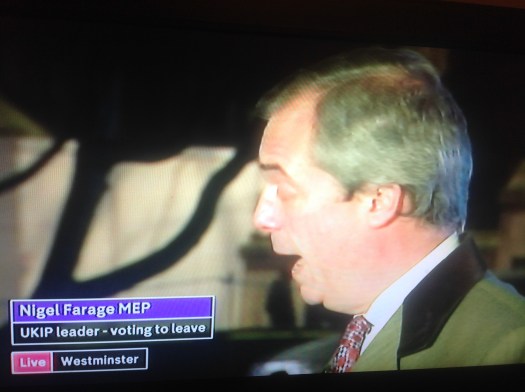
Por último, la entrevista del genial Jon Snow, de Channel 4, en las afueras del Parlamento, a la Secretaria de Estado de Empresas, Anna Soubry, y a Nigel Farage, el polémico líder del partido brexista y anti-inmigración UKIP. Un cínico desaprensivo disfrazado de tío majo. Se me antojaba un duelo entre iguales, pero Soubry le ha dado un repaso bastante completo a Nigel Farage, cuyo machismo simpaticón de terciopelo no le funciona con mujeres hábiles. Soubry, con una astucia cautivadora, ha sabido plantear muy bien la entrevista y  ha dejado a Farage sin argumentos, hasta el punto de forzarlo a decir que ni siquiera quería para Gran Bretaña un estatus de Estado asociado con la UE como el que tienen Noruega y Suiza, que forman parte del Área Económica Europea. “Entonces ¿con quién estaremos aliados en Europa?”, preguntaba la Secretaria de Estado. “Con nadie. Nosotros solos. Independientes”, respondía Farage humillado. La mirada de Soubry merecería un párrafo aparte.

image.jpeg

Y es que la principal baza de los Unionistas, o “Remainers” (de “remain”, quedarse), es que la salida abriría un periodo de dos años de gran incertidumbre tras el cual se consumaría la separación y que nadie en absoluto puede predecir con un mínimo de rigor lo que sucedería con las exportaciones británicas, con la copiosa inversión exterior que recibe y en general con su situación geopolítica. Es muy triste que se tenga que polarizar la campaña entre los dos bandos conservadores: el de los nacionalistas románticos desinformados, que se creen que Gran Bretaña es la Hija de la Polla Roja y que serán de nuevo un imperio, como dice la canción de los Nikkis, y los pragmáticos civilizados que apelan a la incertidumbre económica para que nada, o muy poco, cambie en política. Hace falta ilusión por Europa, por una nueva Europa.

En fin, afortunadamente no es Brexit todo lo que reluce, más bien al contrario.

Boris’ Brexit

Boris Johnson joins Brexit. Most commentators attribute his decision to the need to assert himself in the race for the leadership of the Tory party against the Chancellor George Osborne, but nobody has reflected yet upon the true economic and political significance of Boris Johnson’s move. As the major of the city that harbours the biggest financial centre in the world, and a declared supporter of its financial industry, it would be have been inconceivable for him, and irresponsible, not to have, at least, gauged the mood amongst the leaders of the City’s institutions before making his mind up. Can anybody imagine a conservative major of London standing against the City of London?

In my view, Johnson’s support for Brexit needs to be interpreted in the light of one of the deals achieved last weekend by David Cameron in Brussels: The British Government will be able to object, and delay, the implementation of measures by Eurozone Governments on Monetary Union matters that affect the rest of members of the Union, but will have no right to veto them.

The ability to block Eurozone integration is something that the financial industry had defended for years and the British Government has tried its best to achieve. The Eurozone, as it has become evident following the Great Recession, requires a revamping of its institutional architecture and a more effective, and far more democratic, governance. There are a number of ideas, more or less developed as specific proposals, that could help the Eurozone to address the political and functional shortcomings of the Monetary Union, bringing prosperity and jobs to the Euro countries and, by extension, to the EU as a whole, including Britain. However, some of these ideas might reduce the ability of many London financial institutions to continue working in the way they have done since the European Monetary Union started. Additionally, the City could be affected by any agreement within the Eurozone that touches, directly or indirectly, upon the question of debt (our public and private debt, which is immense. Remember that in our new world order, money is just debt and debt is a powerful political tool. If you need proof of it, watch 4 Horsemen, Boom, Bust, Boom or read the latest work of any alternative economist).

So, in what way could many operators of the City of London benefit from Brexit? Britain’s departure would make the European Union far more unstable and force everybody to rethink their priorities; the question of regulating the activities of the institutions who brought about financial chaos in 2008 will be left in the back burner. Brexit would certainly bring monetary instability for the euro, and the pound, that many will be already betting for and benefiting from. The turmoil caused by the shock of a victory of the No Campaign would prevent the still immature Monetary Union to advance in the direction it needs.

One may argue that Brexit may be detrimental for the city (no capital) of London, but that would not be so much the case for its financial operators. Severing the links with the EU will no doubt force London-based institutions to redeploy parts of their operations in the continent before Brexit is consummated legally, but with state of art technology and the best paid lawyers, it would be easy to minimise the cost of any relocation. At the end of the day, money, as opposed to people, does not have any national feelings.

Meanwhile, it appears that the big industrial corporations of the U.K. are showing their desire for Britain to remain in the EU. Up to 80 of the FTSE100 companies are reported to support Britain’s membership of the EU. For them, the benefits of sharing a common market and being part of a greater economic entity in today’s world are indisputable. For them, migration has brought about the labour they needed to and migrants are seen as an asset, as they are net contributors to the economy who generate more taxation and more consumption. For them, there is no evidence whatsoever that Brexit would generate more investment and more trade to the country. It is a big gamble. The EU “regulations” that so many people complain about would have to be complied with anyway if these corporations want to continue selling good and services to the continent. And, personally, I think Britain, as much as I love it, is one of the most regulating societies in the world. Leaving the EU would not liberate us from suffocating rules, nor make the rules better, believe me. Look at any other aspect of our life and society (Education is a good example) and tell me hand in heart if we don’t have too many rules, protocols, reports, procedures and measurements of our own creation that have nothing to do with the EU.

I am sure plenty of noble ideological and political reasons will be provided by Johnson justifying his stance in no time (today at 10.00 am in the Telegraph, apparently). Well-known anti-EU conservative discourse is widely available in the shelves of Tesco and other major suppliers in all colours and sizes. It is not that Boris does not have the capacity to elaborate his own narrative, but why bothering reinventing the wheel if the pre-packed patriotic democratic neo-romantic stuff is as good as any? Besides, loads of effort has been put in producing the arguments for Brexit by many politicians and commentators, including himself, over the years. Embracing the collective work, using the words and emotions that best resound in our hearts would bring Boris closer to the common man and woman and facilitate his harmonious contribution to the campaign.

However, no matter how appealing his arguments may appear to be, the decision of Boris Johnson to support Brexit reveals the widening gap between the real economy, the one that produces goods and services, which supports overwhelmingly EU membership, and the financial elites, who have decided to rock the boat, using the British people and sectors of the media as a proxy, in order to maintain and improve their position of dominance over States, industries and people across Europe.

Brexit: La división de la derecha

Hoy se ha anunciado la fecha del referéndum en el que los británicos deben decidir si Gran Bretaña abandona la UE o si permanece en ella, bajo las nuevas condiciones que el Primer Ministro conservador David Cameron ha conseguido extraerles al resto de Estados miembros. Será el 23 de junio de 2016.

Destacados miembros del Partido Conservador se han alineado en las dos campañas antagonistas, la del Sí y la del No, las cuales están a su vez divididas en diversas facciones.

Por un lado, dos pesos pesados del Partido Conservador, Michael Gove e Ian Duncan Smith, están desde ayer galvanizando a los numerosísimos militantes y cargos conservadores que reclaman la Brexit (Salida de Gran Bretaña de la UE). El poderoso grupo mediático de Rupert Murdoch y periódicos como el Daily Telegraph no sólo apoyan la Brexit, sino que han contribuido durante años a crear y difundir toda suerte de mitos sobre la UE que han calado profundamente en una gran parte de la sociedad. Los rebeldes conservadores compartirán campaña con el otro partido de la derecha, UKIP, que fue creado precisamente como respuesta anti-europea y anti-inmigración a la tibieza de los conservadores euro-pragmáticos.

Mientras tanto, David Cameron y su Chancellor of the Exchequer, George Osborne, defienden el Sí huyendo instintivamente de aventuras geopolíticas arriesgadas. Recuérdese que hasta Obama va a apoyar la permanencia del país en la UE y que una parte importante de las grandes empresas británicas, hasta un 80% según el Financial Times, va a hacer lo mismo.

El alcalde de Londres, el conservador Boris Johnson, se ha decantado públicamente esta tarde por la Brexit. Su decisión es tremendamente importante no sólo por el gran respeto del que goza en todo su partido y entre parte del público. El pronunciamiento de Johnson nos da una idea de la brecha abierta en la clase empresarial británica en torno a la cuestión europea. Como alcalde de la City of London, mayor centro financiero del mundo, es indudable que Johnson cuenta con el visto bueno de las “instituciones financieras” privadas. La escisión de la clase financiera con respecto a la élite industrial se hace cada vez más patente.

¿Y por qué a los poderes financieros les interesa apoyar la Brexit en estos momentos? David Cameron no ha conseguido en sus negociaciones del fin de semana pasado el derecho a veto de los países de fuera de la Eurozona a las decisiones que se tomen en el núcleo duro de la Unión Monetaria. Eso tiene implicaciones para el sector financiero británico. Tarde o temprano el Euro necesitará una arquitectura política e institucional más firme. Inevitablemente se ejercerán competencias en materias que afectarán a la primacía de Londres como centro financiero en la UE (y que le darían a Frankfurt, su rival continental, el señoreaje que demanda). Además, los intereses de los operadores londinenses, que en realidad carecen de nacionalidad, estarían también en juego si hubiera algún tipo de acuerdo en torno a la deuda entre los países de la Eurozona, lo cual sería posible también sin contar con Gran Bretaña. Por eso, una parte de la City of London, después de muchos años de ambigüedad silente, confirma ahora su órdago secesionista. La reformulación de la gobernanza del Euro aún no ha madurado, la salida de Gran Bretaña provocaría un gran choque que paralizaría la Unión y generaría incertidumbre en torno al euro y a la libra. Debilitar a los Estados es la estrategia de una deudocracia cuyos intereses se alejan cada vez más de los de la economía real.

La única conclusión esperanzadora de todo esto es la constatación, una vez más, de que el “Establishment” o clase dominante de un país no es un bloque homogéneo que actúa siempre con un propósito común. La izquierda en Europa debe aprender a entender y usar estas divisiones.